




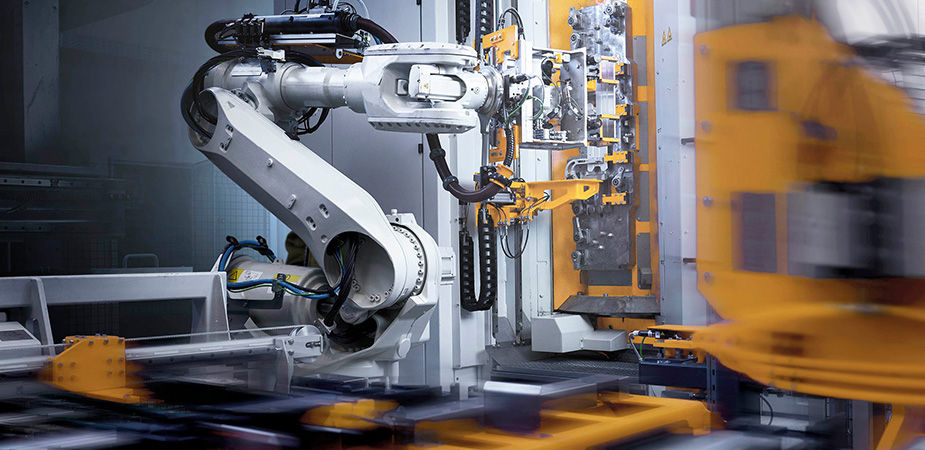
Industrial robots As artificial intelligence and automation converge on the factory floor, industrial robots have become central to the next era of manufacturing. From automotive assembly to pharmaceutical packaging, industrial robots deliver the precision, speed and consistency that modern production demands and they increasingly rely on powerful onboard memory and storage solutions to handle complex, AI-driven workloads.
What is an industrial robot?
An industrial robot is a robot used for manufacturing. Industrial robots are automated, programmable and capable of movement on three or more axes. Typical applications of robots include welding, painting, assembly, disassembly, pick and place for printed circuit boards, packaging and labeling, palletizing, product inspection and testing; all accomplished with high endurance, speed and precision. Industrial robots are heavy-duty machines designed to automate the manufacturing process. They are equipped with at least one robotic arm and often complete repetitive or dangerous tasks in warehouses and factories. The role of industrial robots continues to expand beyond traditional assembly lines, now encompassing quality inspection, machine tending and AI-guided adaptive manufacturing — all of which demand robust, industrial-grade compute and data storage resources.
How does an industrial robot work?
An industrial robot works by using programmed instructions, sensors, controllers and mechanical components to perform tasks automatically with speed, accuracy and consistency. Many industrial robots are designed to repeat the same task with a high degree of precision, following predefined routines that control movement, direction, speed, acceleration and positioning. More advanced industrial robots can adapt to changing conditions, identify objects and adjust their actions based on real-time inputs. To improve accuracy, these robots often use machine vision systems that act as visual sensors and connect to powerful controllers or computers. Artificial intelligence also plays an increasingly important role, enabling robots to make decisions and operate in more complex environments.
There are three primary ways to tell an industrial robot what to do:
- Teach pendant programming : An operator manually jogs the robot to each position in a sequence, records those positions and writes the logic that connects them; straightforward but time-consuming for complex paths.
- Lead-through programming : An operator physically guides the robot's arm through the desired motion; the controller records every movement in real time, ideal for tasks like spray painting.
- Offline programming : Engineers build a virtual model of the robot and its workspace, simulate and optimize the program on a computer before running it on the real machine; the standard for complex, high-volume operations.
To support machine vision, AI applications, operational logging and real-time decision-making, industrial robots rely on memory and storage to process, store and access data quickly and reliably. As robots become more autonomous and data-intensive, high-performance memory and storage have become critical components of modern robotic systems.
Real-time operating systems (RTOS) and deterministic control loops require reliable, industrial-grade DRAM, often with error-correcting code (ECC) capabilities to ensure system stability. Increasing program complexity, machine vision workloads, data logging requirements and digital twin applications also drive demand for greater memory capacity and faster, more durable storage solutions, including high-endurance SSDs with power-loss protection.
What is the difference between an industrial robot and a collaborative robot?
Traditional industrial robots operate behind safety fencing and have no built-in ability to detect a person who wanders into their path. Collaborative robots, or cobots, use built-in force and torque sensors that detect unexpected contact and stop the robot before it can cause injury — they can be placed directly into existing production lines with little or no additional safety infrastructure. Cobots typically handle lighter payloads and move more slowly, making them faster and more cost-effective to deploy for small and mid-sized manufacturers.
What are degrees of freedom (DoF)?
Degrees of freedom (DoF) describe how many independent ways a robot can move, such as up and down, forward and backward, side to side, or rotating around a joint. In industrial robotics, DoF helps define how flexible and capable a robot is in a manufacturing environment, as more degrees of freedom enable the robot to reach, position and manipulate objects with greater precision. Movement on three or more axes is one of the factors that classify a robot as industrial. The robot has the motion capability needed to perform complex manufacturing tasks.
What is the history of industrial robots?
Industrial robotics has evolved from simple mechanical arms into AI-powered, sensor-rich systems over nearly a century of innovation.
- 1930s : The earliest known industrial robot was completed by "Bill" Griffith P. Taylor in 1937 — a crane-like device built almost entirely using Meccano parts, powered by a single electric motor, capable of stacking wooden blocks in pre-programmed patterns.
- 1950s–60s : George Devol applied for the first robotics patents in 1954. Unimation, the first robot manufacturing company, was founded in 1956 and produced programmable transfer machines accurate to within 1/10,000 of an inch. The first industrial robot joined General Motors' assembly line in 1961.
- 1960s–70s : In 1969, Victor Scheinman at Stanford University invented the Stanford arm, an all-electric, 6-axis articulated robot designed to accurately follow arbitrary paths in space, widening the potential use of robots to sophisticated assembly and welding applications.
- 1973 : Industrial robotics took off in Europe, with both the Swedish–Swiss company ABB Robotics and Germany's KUKA Robotics bringing robots to the market in 1973.
- 2000s–Present : The biggest shift happening now is the integration of artificial intelligence and machine vision into robots that were previously limited to following pre-programmed paths. Digital twins, virtual replicas of a physical robot and its environment, let engineers test changes in simulation before pushing them to the factory floor. When combined with reinforcement learning, this allows robots to optimize their movements for speed and energy efficiency over time.
What are the key types of industrial robots?
Industrial robots come in several mechanical configurations, each designed for different tasks, workspaces and levels of flexibility. The most common types are articulated, SCARA, delta and cartesian robots, which are widely used across manufacturing, logistics and assembly operations. Other configurations, such as cylindrical and polar robots, are typically used for more specialized industrial applications.
1. Articulated robots
Articulated robots resemble a human arm and use multiple rotating joints to achieve a wide range of motion. Most industrial articulated robots have six axes, allowing them to reach around obstacles and approach a workpiece from multiple angles. Their flexibility makes them a popular choice for welding, painting, material handling and complex assembly tasks.
2. SCARA robots
Selective compliance articulated robot arm (SCARA) robots are designed to move freely in the horizontal plane while remaining rigid in the vertical direction. This combination of speed and precision makes them well-suited for high-volume assembly operations, such as inserting components, placing parts on circuit boards and transferring products between workstations.
3. Delta robots
Delta robots, sometimes called spider robots, are suspended above the workspace and use three lightweight arms connected to a central platform. Their design enables extremely fast and precise movements, making them ideal for pick-and-place applications in industries such as food processing, pharmaceutical packaging and electronics manufacturing.
4. Cartesian robots
Cartesian robots move along three linear axes, allowing precise motion in the X, Y and Z directions. Their straightforward design provides excellent accuracy and repeatability for applications such as CNC machine tending, 3D printing and material handling. Larger cartesian systems mounted on overhead rails are often referred to as gantry robots.
5. Cylindrical robots
Cylindrical robots feature a rotating base combined with linear movement, creating a cylindrical work envelope. Their compact design allows them to operate efficiently in confined spaces, making them a practical choice for machine tending, welding, assembly and packaging applications.
6. Polar (spherical) robots
Polar robots, also known as spherical robots, use a combination of rotary and linear joints to create a wide spherical range of motion from a fixed base. This design allows them to reach areas that may be difficult for other types of robots to access, making them useful for applications such as die casting, injection molding and machine tending.
What are industrial robots used for?
Industrial robots make products, perform highly repetitive tasks and assist in groundbreaking procedures. This versatility makes robotics prevalent in nearly every industry. Adoption is accelerating outside of the automotive industry, particularly in food and beverage, logistics and pharmaceuticals, as robots become easier to program and deploy.
- Automotive manufacturing : Both spot welding (joining sheet metal with localized heat) and arc welding (running a continuous bead along a seam) are heavily automated; robots handle the repetitive, physically demanding torch work while maintaining consistent quality across thousands of welds.
- Electronics assembly : Industrial robots perform pick and place for printed circuit boards with precision that enables tight component tolerances critical to modern semiconductor devices.
- Food and beverage : Delta robots handle rapid pick-and-place cycles for sorting food products at high speed, while automated palletizing solutions have improved productivity by over 50% in some facilities.
- Pharmaceuticals : In the medical field, industrial robots have automated tasks like dispensing medications, handling delicate instruments and even assisting in surgery — contributing to precision and repeatability in processes critical to patient care and safety.
- Logistics and e-commerce : Industrial robots pick, sort and pack products with speed and accuracy to complete order fulfillments, assisting industries with high-volume warehouse operations.
- Quality inspection : Equipped with advanced sensors and vision systems, industrial robots identify defects, measure dimensions and ensure that products meet strict quality standards.
Why do industrial robots require industrial-grade memory and storage?
Modern industrial robots depend on memory and storage to process machine vision data, run AI workloads, store operating software and support real-time control systems. Because robots often operate in environments exposed to shock, vibration, temperature fluctuations and continuous workloads, they require reliable industrial-grade memory and storage solutions designed for long-term performance and endurance.
Industrial robots can take on tasks that expose workers to heat, heavy lifting, hazardous materials, repetitive strain or dangerous equipment. By reducing employee exposure to these risks, robots can help create safer work environments, improve employee satisfaction and retention while lowering the likelihood of workplace injuries.
More than 4.6 million industrial robots are operating in factories worldwide. According to the International Federation of Robotics (IFR), the global operational stock of industrial robots reached an all-time high in 2024, reflecting continued growth as manufacturers invest in automation, productivity improvements and smart factory technologies.