




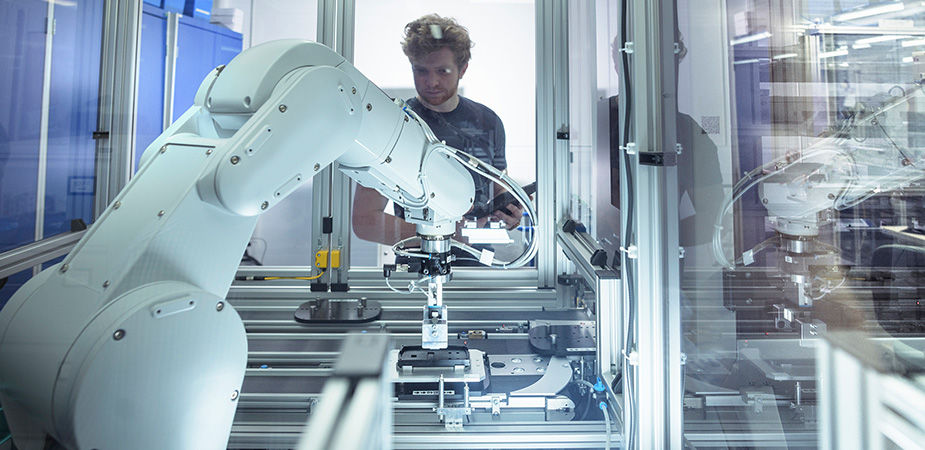
Collaborative robots (cobots) The global factory floor is undergoing its most significant transformation in decades, as manufacturers race to combine human dexterity with robotic precision at scale. Across industries from electronics assembly to automotive production, organizations are deploying a new generation of robotic systems designed not to replace human workers — but to work safely beside them. Collaborative robots, commonly known as cobots, represent a fundamental shift in how automation is deployed, enabling flexible, human-centered production environments that traditional industrial robots cannot support.
What are cobots?
Collaborative robots, or cobots, are robotic systems designed for direct, close-range interaction with human workers in a shared workspace, without the need for protective cages or barriers. Unlike conventional industrial robots that operate in isolation, cobots integrate built-in force sensing, collision detection and multi-level safety systems that allow them to slow, stop, or transition into a protective mode when a person is detected nearby.
Cobots occupy a distinct category within industrial automation. They are engineered for flexibility: deployable in hours rather than weeks, programmable through drag-and-teach interfaces, and capable of adapting to changing production needs without extensive reconfiguration. As cobot intelligence grows, powered by machine learning and advanced vision systems, their controllers require increasingly robust memory and storage to handle real-time sensor data, vision buffering, safety logic, and connectivity demands.
How do collaborative robots work?
Cobots operate by continuously monitoring their environment through integrated sensors and executing safety responses in real time. Their control systems combine force-torque feedback, vision perception, and motion planning to enable human-robot collaboration across a shared workspace.
Key components and mechanisms include:
- Force-torque sensing: The cobot detects contact forces at the wrist, enabling compliant motion, precise insertion tasks, and safe collision response.
- Vision systems: 2D and 3D cameras allow cobots to locate objects, scan barcodes, perform defect inspection, and support bin - picking in unstructured environments.
- Safety-rated motion control: Graduated collision protection monitors speed, separation, and force limits across multiple safety levels simultaneously.
- Lead-through programming: An operator physically guides the cobot arm through a desired path; the system records and replays the trajectory without requiring programming expertise.
- Industrial connectivity: EtherCAT fieldbus and Ethernet protocols (TCP/IP, Modbus-TCP) integrate cobots with manufacturing execution systems (MES), sensors, and programmable logic controllers (PLCs).
- Embedded controller: The cobot's onboard controller relies on industrial-grade memory and data storage to handle deterministic real-time operating system (RTOS) workloads, vision data buffering, and operational logging across 10-plus year lifecycles.
How does cobot programming work?
Cobot programming is the process of teaching a collaborative robot how to perform specific tasks, such as assembly, inspection, packaging, or material handling. Unlike traditional industrial robots that often require specialized coding skills, many cobots are designed to be programmed quickly by operators with limited robotics experience.
Most cobots can be programmed using a graphical interface, drag-and-drop workflow tools, or hand-guiding, where an operator physically moves the robot arm through the desired motions. The robot records these positions and actions, then repeats them with consistent speed and precision. More advanced applications may integrate machine vision, sensors, and artificial intelligence to help cobots identify objects, adapt to changing conditions, or make real-time decisions.
Once programmed, the cobot's controller coordinates movement, sensor inputs, and safety features to execute tasks while working alongside human employees. This combination of ease of use, flexibility, and automation makes cobots practical for applications ranging from manufacturing and logistics to healthcare and laboratory environments.
What are the levels of human-robot collaboration?
The International Federation of Robotics (IFR) defines four levels of human-robot collaboration, ranging from simple shared space to real-time dynamic interaction. Understanding these levels helps manufacturers select the right cobot configuration, safety architecture, and memory and compute infrastructure for their specific application.
1. Coexistence
Coexistence is the foundational level of human-robot collaboration, in which humans and robots share the same physical space but operate without a shared workspace or direct interaction. The robot performs its task independently while the human works nearby — no safety fence is required, but the two workstreams do not intersect.
This level is common in facilities transitioning away from fully caged industrial robots. It delivers immediate floor-space savings and removes the physical barriers that limit workflow flexibility, while maintaining a clear separation of tasks. Safety is managed through proximity sensors and speed monitoring rather than physical enclosure.
- Typical applications: parallel assembly stations, adjacent inspection workflows, shared production floor layouts
- Key safety mechanism: speed and separation monitoring — the cobot reduces speed as humans approach its operational zone
- Controller demand: moderate — real-time motion control and proximity sensing with standard RTOS workloads
2. Sequential collaboration
In sequential collaboration, humans and cobots actively share a workspace but interact with the same part or workstation at different times, never simultaneously. One party completes a task and steps away before the other begins, creating a structured handoff rhythm.
This level unlocks significant productivity gains by enabling human workers to focus on judgment-intensive steps, such as quality verification or complex orientation, while the cobot handles repetitive upstream or downstream tasks. Precise sequencing logic and reliable data storage ensure accurate handoff states are maintained across every production cycle.
- Typical applications: machine tending, kitting and assembly staging, inspection-then-packaging workflows
- Key safety mechanism: safety-rated monitored stop — the cobot halts when a human enters the shared zone and resumes when they exit
- Controller demand: moderate to high — handoff state management, cycle logging, and sensor coordination require durable industrial storage
3. Cooperation
Cooperation represents a significant step up in complexity: Both the human and the cobot work on the same part at the same time, with both in motion simultaneously. This level demands that the cobot continuously adapt its force, speed, and path in response to the human worker's actions in real time.
Cooperation unlocks human-robot workflows that neither party could perform alone — such as large-part assembly requiring two sets of hands, or precision operations where a human guides placement while the cobot applies controlled torque. The computational demands at this level are substantially higher, requiring low-latency sensor fusion, fast memory access, and robust embedded storage to sustain deterministic control loops without interruption.
- Typical applications: large-panel assembly, guided welding, complex fixture alignment, ergonomic lift-assist tasks
- Key safety mechanism: power and force limiting — the cobot continuously monitors and caps contact force to safe thresholds throughout the shared task
- Controller demand: high — simultaneous sensor fusion, force-torque processing, and real-time path adaptation place significant demand on industrial-grade DRAM and storage
4. Responsive collaboration
Responsive collaboration is the most advanced level, in which the cobot responds dynamically and continuously to the real-time movement of the human worker, adjusting its trajectory, speed, and behavior without predefined handoff points or fixed sequences. The human and robot operate as genuine partners, with the cobot anticipating and reacting to human intent.
This level relies heavily on artificial intelligence and machine learning to interpret human motion, predict next actions, and execute adaptive responses within milliseconds. The onboard controller must process continuous multi-modal sensor streams — vision, force, proximity, and position — while maintaining real-time safety compliance. Industrial-grade memory with error-correcting code (ECC) capability and high-endurance storage are essential to sustain this level of performance reliably across long production shifts and multi-year operational lifespans.
- Typical applications: adaptive human-guided assembly, real-time ergonomic support, AI-driven collaborative inspection
- Key safety mechanism: full multi-modal sensor fusion with AI-driven motion prediction and graduated force response
- Controller demand: very high — continuous AI inference, multi-sensor data processing, and deterministic real-time control require the highest levels of memory bandwidth, ECC reliability, and storage endurance
What is the history of collaborative robots?
Cobots have evolved from early research prototypes into a commercially dominant segment of industrial automation, driven by advances in sensing, AI, and embedded computing.
- 1980s: Theoretical foundations for compliant robots, capable of detecting forces and being hand-guided, are established at Stanford University and refined at the German Aerospace Center.
- 1994-1996: A General Motors initiative leads to the invention of cobots by professors J. Edward Colgate and Michael Peshkin at Northwestern University; the patent for "Cobots" is filed in 1997.
- 2002: The Robotic Industries Association publishes the first draft safety standard (RIA BSR/T15.1) for Intelligent Assist Devices.
- 2011: The American National Standards Institute (ANSI)/RIA R15.06 robot safety standard is updated, harmonizing with International Organization for Standardization (ISO) 10218-1 and ISO 10218-2.
- 2016: ISO/TS 15066 is published, providing the first dedicated technical specification for collaborative robot safety requirements and four collaborative operation modes.
- 2025-2026: ISO 10218-2:2025 integrates ISO/TS 15066 requirements, reflecting industry recognition that safety is determined by application context, not robot type alone. The global cobot market reaches an estimated US$2.8-3.6 billion, growing at over 20% annually.
What are the key types of collaborative robots?
Cobots are classified by payload capacity, application grade, and environmental protection level. This taxonomy enables manufacturers to select the right system for their specific production environment, from precision electronics assembly to heavy industrial palletizing.
1. By payload capacity
- Light-duty (≤6 kilograms): Optimized for electronics assembly, screw driving, labeling, and quality inspection; dominate global installation counts.
- Medium-duty (6-12 kg): Covers the broadest range of general industrial tasks including welding, machine tending, and palletizing; highest-demand segment.
- Heavy-duty (>12 kg): Supports large-part handling and demanding machining; models reach 30 kg payload with up to 1,800-millimeter reach.
2. By application grade
- Consumer-grade: Cost-effective systems for service environments (food service, retail, eldercare); typically have an ingress protection (IP) rating of IP66.
- Industrial-grade: High speed and precision for automotive parts, electronics, and general machining; IP54-IP65 rating.
- Automotive-grade: Manufactured under International Automotive Task Force (IATF ) 16949:2016 for reliable, long-life operation under tight quality tolerances.
- Explosion-proof: Certified for hazardous environments (gas, dust, flammable materials); IP68 rating with ATEX/IECEx certification.
- Extreme-temperature — Engineered to operate from minus 30 C to 80 C; deployed in cold-chain warehousing, hot forging, and similar environments.
How are collaborative robots used?
Collaborative robots are deployed across a wide range of industries and applications, enabling automation of repetitive, ergonomically challenging, or precision-critical tasks while allowing people to focus on tasks that require judgment, problem-solving, and creativity.
1. Manufacturing and assembly
Collaborative robots are widely used in manufacturing environments to support assembly and production processes. In electronics manufacturing, cobots perform tasks such as precision screwdriving, component placement, and quality inspection on semiconductor and printed circuit board (PCB) production lines. In automotive manufacturing, they work alongside employees to handle fastening, welding, painting, and part movement on mixed-model assembly lines. Cobots are also commonly used for machine tending, automatically loading and unloading computer numerical control (CNC ) machines, injection molding equipment, and stamping presses to improve equipment utilization and reduce downtime.
2. Quality inspection and testing
Many cobots are equipped with advanced vision systems and AI-powered software that enable automated quality control. These systems can identify surface defects, inconsistencies, or product variations that would otherwise require significant manual inspection effort. Cobots can also use force and torque sensors to perform precise measurements and testing procedures, ensuring products meet quality standards while maintaining consistent contact force and repeatable results.
3. Logistics and warehousing
In warehouses and distribution centers, collaborative robots help streamline material handling operations. They are frequently used for palletizing and depalletizing, automating the stacking and unstacking of products to reduce repetitive lifting tasks. Vision-guided cobots can also perform pick-and-place operations, identifying and handling items in dynamic environments to support order fulfillment and inventory movement.
4. Healthcare and laboratory operations
Collaborative robots are increasingly being adopted in healthcare and laboratory settings where accuracy and consistency are critical. In pharmacies, cobots can sort, dispense, and organize medications with high repeatability. In clinical and research laboratories, they assist with sample handling and preparation, helping reduce contamination risks while minimizing repetitive tasks that can contribute to operator fatigue.
What is the future of collaborative robots?
The future of collaborative robotics depends on more than mechanical precision. As cobots become increasingly autonomous and AI-driven, they must continuously process data from cameras, sensors, and connected factory systems while making real-time decisions alongside human workers. These growing compute demands require advanced memory and storage capable of supporting low-latency performance, data integrity, and long operational lifecycles. As a leader in memory and storage innovation, Micron helps provide the foundation that enables smarter, safer, and more capable cobots across modern manufacturing environments.
Cobots operate beside human workers without safety cages; traditional industrial robots require physical barriers to protect people nearby. Cobots are programmed through drag-and-teach interfaces and deploy in hours, while traditional robots typically require specialized programming and weeks of installation. Traditional robots generally offer higher speed and payload for fixed, high-volume lines; cobots deliver flexibility and human-robot collaboration for mixed workflows and smaller operations.
Cobotics, short for collaborative robotics, is the branch of technology that deals with the practice of humans and robots working together in a shared workspace. Unlike traditional industrial robots that typically operate behind safety barriers, cobotics systems are designed to safely assist people with repetitive, physically demanding, or precision-based tasks while humans remain responsible for activities that require judgment, adaptability, and decision-making.
Cobots accelerate smart manufacturing by generating continuous sensor, vision, and operational data that AI systems analyze for predictive maintenance, quality control, and process optimization. As cobots handle increasingly complex tasks guided by machine learning models, their embedded controllers require industrial-grade memory and storage solutions, including ECC DRAM and high-endurance SSDs, to sustain deterministic real-time performance, data integrity, and long lifecycle reliability across demanding factory environments.