Welcome to Micron.com, please Log in or Register an account to continue.






How Micron leaders see the future of AI
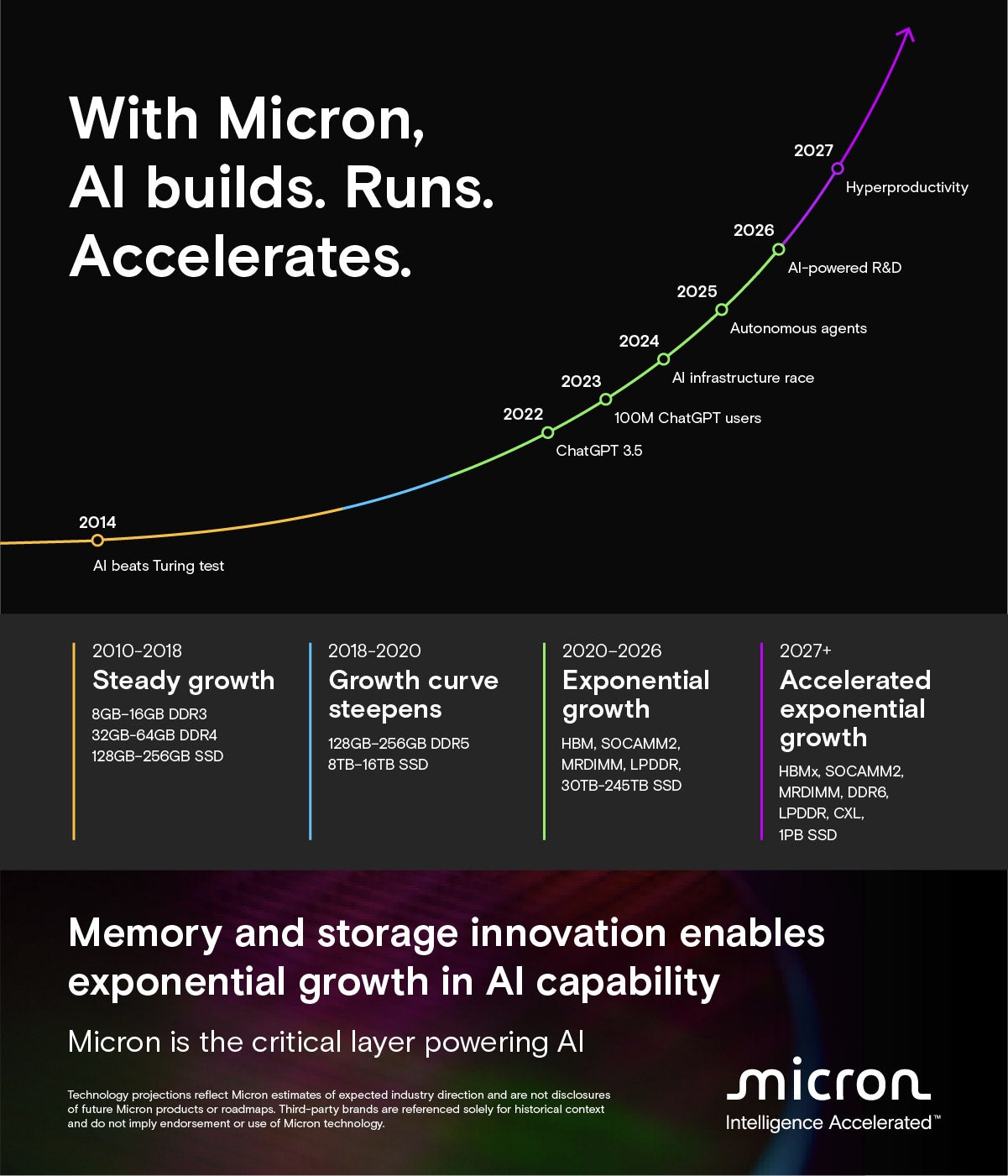
Micron executives share their perspectives on how data, memory and storage power AI, driving scale and speed to accelerate human potential.







- AI data rooted
- Sanjay quote
- AI data business
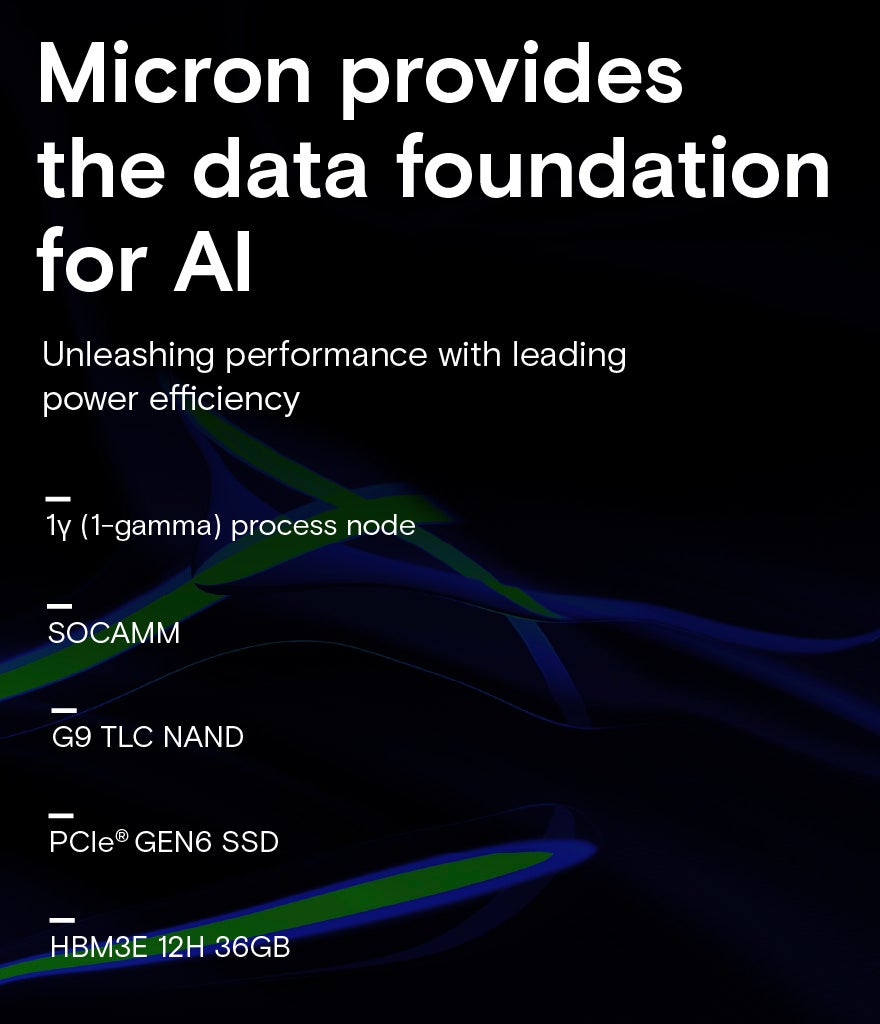
- AI data foundation
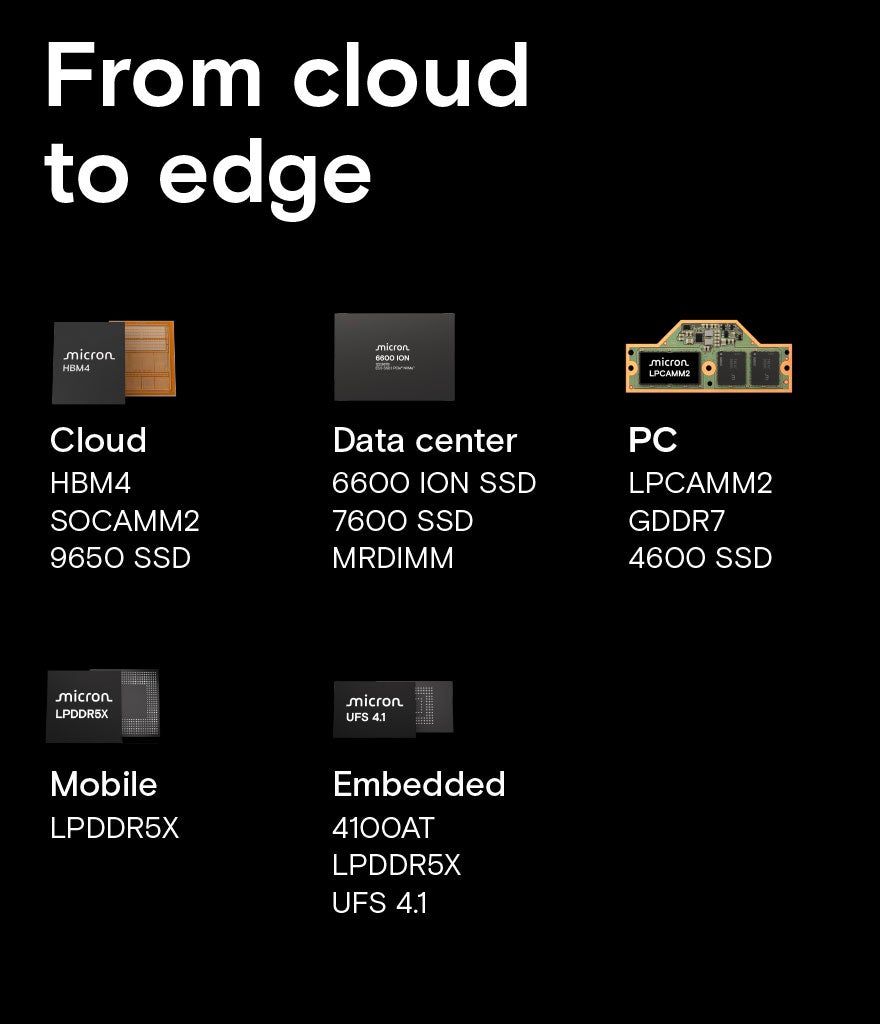
- AI data cloud to edge



- AI data rooted
- Sanjay quote
- AI data business
- AI data foundation
- AI data cloud to edge
AI doesn’t wait. Neither does Micron.
Learn why Micron’s industry-leading AI memory and storage solutions are foundational to AI infrastructure.




From cloud to edge
AI moves to where the data is. From cloud to edge devices, explore how Micron supports artificial intelligence solutions in these growing segments.


Learn from the experts
AI changes fast. Brush up on AI terminology by exploring the Micron glossary.
Frequently asked questions
Advanced AI technology solutions require artificial intelligence products that can support your complete data pipeline.
Micron’s leading-edge design and manufacturing capabilities produce a broad portfolio of memory and storage solutions which place it at the heart of your data center, giving your AI solution the bedrock foundation it needs.
- High-bandwidth memory (HBM): Products like HBM3E and HBM4 are designed for AI accelerators — providing ultra‑high bandwidth and close‑coupled memory access needed to train and run large‑scale AI models. HBM supports data‑intensive workloads such as model training and high‑throughput inference, where maximizing parallel compute performance is critical. Read the HBM4 press release.
- DRAM: Micron offers high-capacity, low-power DRAM modules and DRAM components that serve as the system’s working memory for AI — supporting active data, model parameters and runtime operations across data centers, AI PCs, mobile devices and automotive systems where speed, efficiency and responsiveness matter.
- Solid-state drives (SSD): High-performance data center SSDs (like the Micron 9650 NVMe SSD and 6600 ION NVME SSD) are used for data-hungry AI workloads, accelerating the ingestion and processing of large datasets and preventing expensive GPUs from idling.
Memory and storage are foundational to AI infrastructure because they form the working space where AI workloads operate — determining how fast, efficiently and cost‑effectively systems can move, process, and retain data across training and inference workflows.
Memory, such as DRAM and HBM, keeps active AI models, parameters and datasets close to processors and accelerators. As AI models grow in size and complexity, high‑capacity, high‑bandwidth memory is critical to reducing data bottlenecks, improving utilization of graphics processing units (GPUs) and AI accelerators and enabling faster model training and real‑time inference.
Storage, including NAND‑based SSDs, supports the massive volumes of data that AI requires, from raw training data to checkpoints and trained models. High‑performance, low‑latency storage enables faster data ingestion, rapid access to large datasets and efficient scaling across data centers and edge environments.
Together, memory and storage:
- Enable faster AI training and inference by minimizing data movement delays
- Support larger, more sophisticated models with higher capacity and bandwidth
- Improve energy efficiency and total cost of ownership by optimizing data flow
- Scale across cloud, enterprise, automotive and edge AI deployments
As AI continues to evolve, balanced innovation across compute, memory and storage is essential. Advances in memory and storage technologies help ensure AI infrastructure can scale performance, efficiency and reliability to meet the demands of next‑generation AI workloads.
Micron accelerates AI by strengthening the memory and storage foundation of modern AI infrastructure. From high‑bandwidth memory (HBM) and AI memory close to accelerators, to AI storage and SSDs for AI that support data ingest, checkpointing and inference, Micron helps keep data moving efficiently through the AI pipeline.
By focusing on performance per watt, bandwidth and scalability, Micron enables artificial intelligence solutions to scale sustainably across data center and edge environments — turning data into intelligence faster and more efficiently.