



The challenge: VM sprawl and aging infrastructure
Enterprise data centers face a growing tension. Virtual machine (VM) sprawl continues unchecked, with more workloads, more VMs, and more pressure on infrastructure teams to consolidate. Yet the platforms typically running these workloads are showing their age. Storage bottlenecks throttle performance. Memory capacity can’t keep pace with VM density. Organizations need to consolidate, but what does that look like on modern hardware? What are the right hardware platforms, storage, CPU, and memory choices for high-performance VMware vSAN® 9.0 with Express Storage Architecture™ (ESA) deployments?
Proven VMware performance: a new world record
A four-node cluster. 334 virtual machines. A VMmark 4 score of 12.4. This is the new world record, validated January 20, 2026, according to VMware. It beats the previous record by 18.1% and adds 48 VMs to the same cluster footprint. The teams documented the results in a reference architecture, which details the findings here . This blog summarizes the work and results.
| Metric | New Record | Prior Record | Improvement |
| VMmark Score | 12.4 | 10.5 | +18.1% |
| Tiles | 15.4 | 13.0 | +18.5% |
| Total VMs | 334 | 286 | +48 VMs |
VMmark 4 is VMware’s data center benchmark. It runs real workloads like databases, web apps, Kubernetes containers, and microservices across a cluster and measures sustained performance from “tiles.” Each tile represents a complete workload set. More tiles mean more useful work from identical hardware. The benchmark enforces quality-of-service thresholds: you can’t cram VMs in without meeting performance standards for throughput and latency.
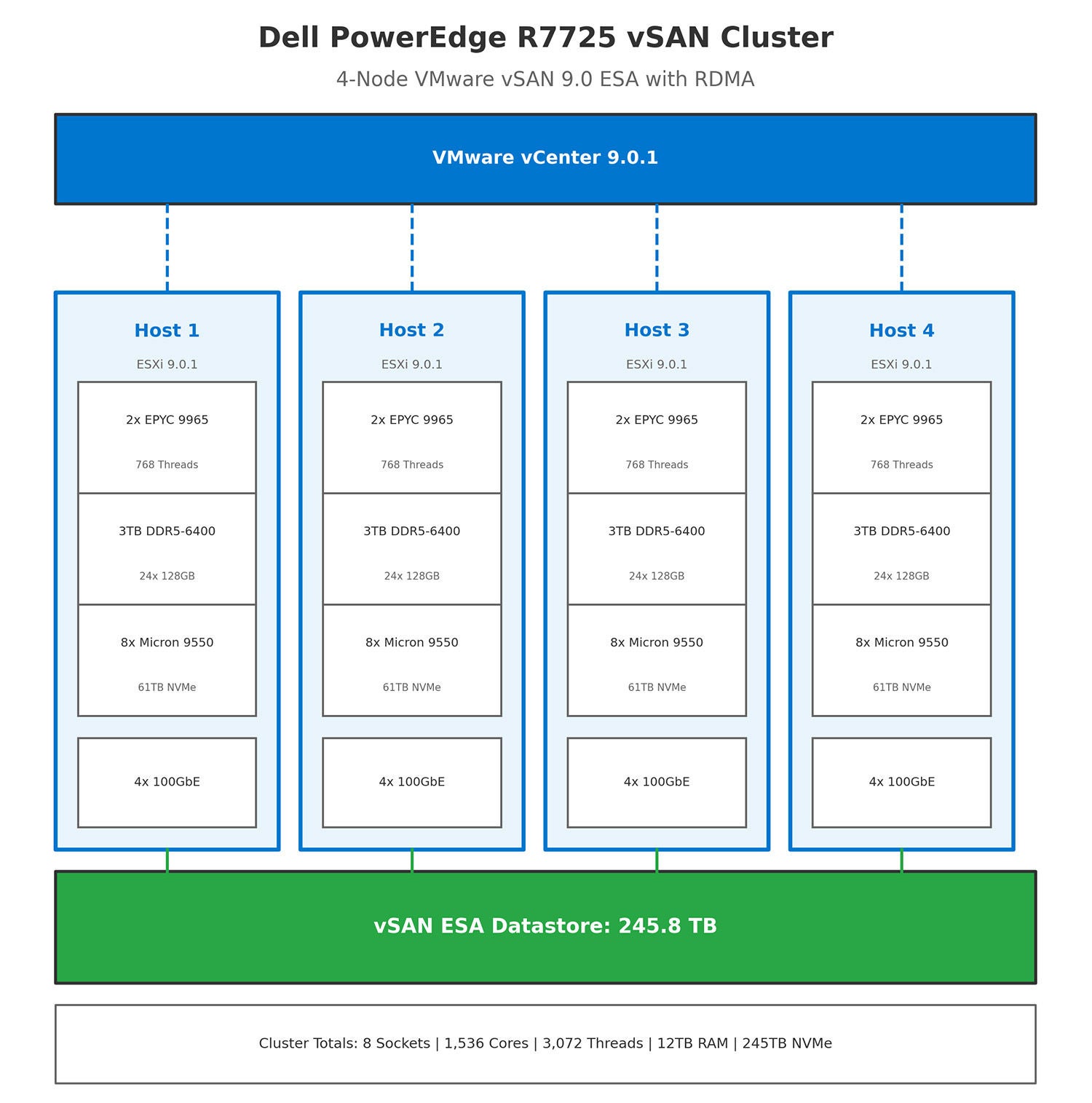
(click image to enlarge)
Four-node vSAN cluster architecture diagram showing Dell PowerEdge R7725 servers
Platform: Dell PowerEdge® R7725 with AMD® EPYC™ 9965
Dell achieved this validated world record on PowerEdge R7725 servers. The R7725 uses dual AMD EPYC 9965 processors with 192 cores per socket, 384 cores per host, 1,536 across the cluster. More cores mean more VMs per host before hitting CPU contention.
Storage: Micron 9550 PRO Gen5 SSDs
Each host ran 8× Micron 9550 PRO NVMe SSDs (7.68 TB, PCIe Gen5, E3.S form factor). The 9550 PRO delivers 3.3 million random read IOPS per drive, up to 120% higher rated IOPS compared to the prior record holder’s Samsung PM1735a Gen4 SSDs (based on published specifications).
Memory: 128GB Micron DDR5-6400 RDIMMs
Memory kept pace. Each host populated 24× 128 GB Micron DDR5-6400 RDIMMs for 3,072 GB per host, enabling 32GB of DRAM per VM. High-capacity memory helps ensure higher VM counts have the resources they need to hit peak performance.
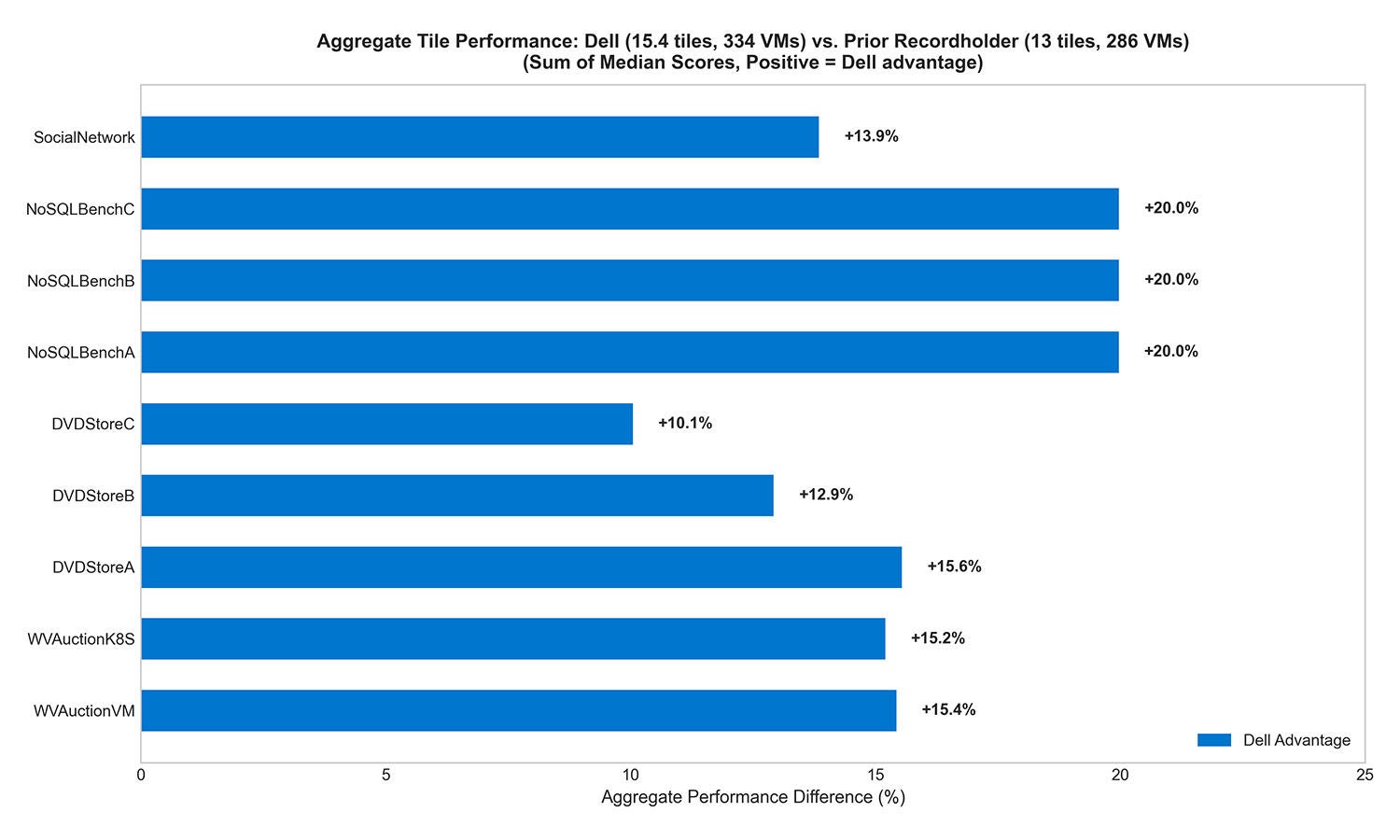
(click image to enlarge)
VMmark 4 aggregate tile performance chart comparing Dell vs prior record holder
Software stack: VMware vSAN 9.0 ESA with RDMA
The software stack enabled higher performance, and vSAN 9.0 handled NVMe flash natively. VMware states that vSAN Express Storage Architecture (ESA) is a redesigned storage architecture optimized to fully exploit high-performance NVMe solid-state storage (“vSAN Technology Overview” vmware.com).
Workload performance gains
VMmark 4 runs five distinct workloads. Storage-intensive workloads saw the largest improvements over the previous VMmark 4 + vSAN record holder:
What this means
The problem we solved: 334 VMs on 4 hosts works out to 84 VMs per host, 48 more than the prior record on the same cluster size. PCIe Gen5 provides 2× the interface bandwidth of Gen4, leaving headroom for future workload growth.
For Dell: The PowerEdge R7725 with AMD EPYC 9965 processors delivers the compute density and memory bandwidth required for high-density VM consolidation. Dell’s integration of Gen5 storage and RDMA networking creates a reference architecture that infrastructure teams can deploy with confidence.
For Micron: The Micron 9550 PRO SSDs deliver 120% IOPS improvement over Gen4 drives directly translated to workload gains: 20% for Cassandra, 13-15% across web and database workloads (see aggregate performance chart above). Pairing Gen5 SSDs with DDR5-6400 memory keeps the entire data path running at full speed.
For Customers: Infrastructure teams planning a refresh can do more with less. Consolidate more VMs per host. Reduce cluster sprawl. Future-proof your investment with PCIe Gen5 headroom. The storage layer no longer holds you back.
Achieving a world record takes coordination across multiple engineering teams.
It takes a village ...
This world record result reflects the collaborative effort of engineering teams across Dell Technologies and Micron Technology.
Dell Technologies:
Jay Engh, Senior Principal Systems Development Engineer
Charan Soppadandi, Principal Systems Development Engineer
Jeremy Johnson, Senior Principal Engineer, Technical Marketing
Mohan Rokkam, Marketing and Product Manager
Micron Technology:
Amit Bodas, Partner, Engineering / Technical Marketing
To learn more about this world record, check out the following links:
- Dell VMmark 4 world record
- Prior VMmark 4 vSAN recordholder
- VMware VMmark 4 benchmark documentation
- Dell PowerEdge R7725 technical specifications
- Micron 9550 PRO SSD technical product specification
- Micron DDR5 RDIMM specifications
- VMware Cloud Foundation 9.0 vSAN documentation
- AMD EPYC 9965 processor datasheet