



As AI workloads increasingly shift to client and edge platforms, power efficiency has become a critical constraint on system performance, battery life, and user experience. Many AI use cases — such as background inference, content creation, and on-device assistants — require storage that can deliver high performance when needed while minimizing energy consumption during both idle and activity periods.
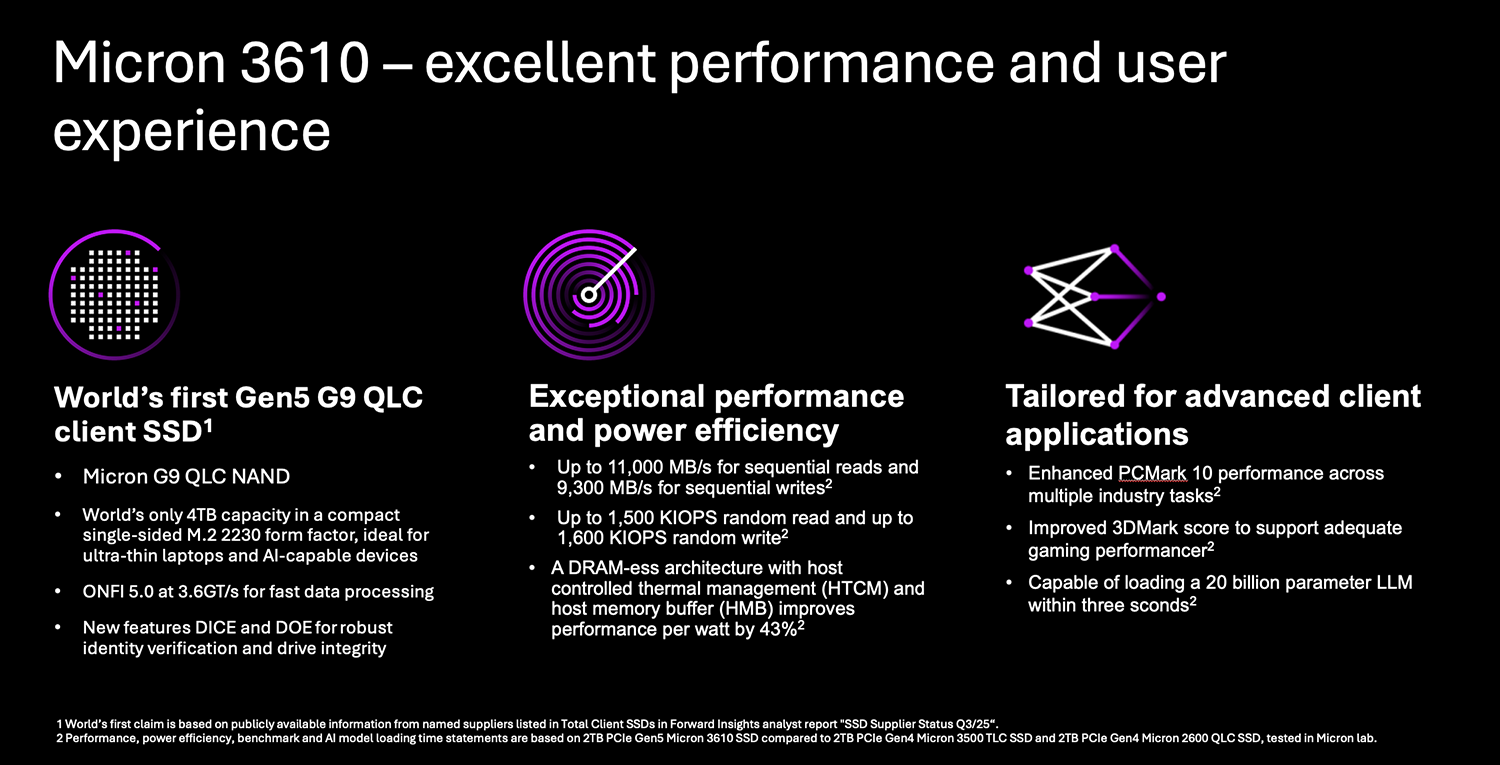
The Micron 3610, the world’s first PCIe® Gen5 G9 QLC client SSD, addresses this challenge through system-level power optimization. It delivers up to a 74% reduction in active idle power and up to 43% performance-per-watt gains compared to PCIe Gen4 TLC client SSDs.1 These advances enable longer battery life and sustained performance for AI-driven client applications.
Why is power the new constraint for edge AI?
The global edge AI market is projected to grow significantly to more than USD 100 billion in 2034, driven by the increasing demand for real-time data processing and the rapid advancements in edge computing technologies.2,3 With more AI tasks now running locally on edge devices like smartphones and computers to boost speed and enhance security, power consumption — not raw performance — is becoming the primary constraint on user experience. The shift is posing challenges for system designers to prioritize power budgets to enable device feature advancement without draining battery life.
In August 2025, Micron published this LPDDR5X voltage scaling blog and demonstrated how voltage scaling empowers low power DRAM LPDDR5X to provide an efficient AI user experience in smartphones. While technology innovation continues at a rapid pace, Micron’s commitment to provide cutting-edge memory and storage solutions never stops.
Micron 3610: A power efficient client SSD for AI era
 3610 key differenciations
Click image to expand
At CES 2026, Micron debuted the 3610, the world’s first PCIe Gen5 client SSD built on Micron’s G9 QLC NAND. By combining top performance with substantial reductions in active idle power and performance per watt, the Micron 3610 addresses a key challenge in edge AI platforms: sustaining high performance while minimizing energy consumption.
Lower active idle power consumption
 Active idle power and battery life comparison
Click image to expand
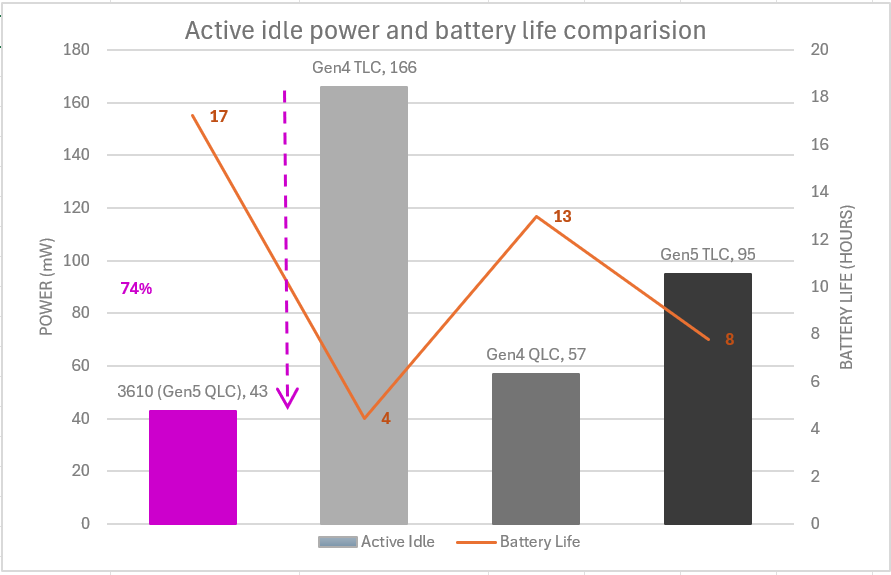
For NVMe™ client SSDs, active idle power mode represents the intermediate state between active data transfer and sleep. Reducing the active idle power level impacts energy usage during the active sleep transition, which in turn prolongs battery life. Micron labs testing shows that the 3610 SSD consumed only 43mW in active idle power mode. In comparison, the Gen4 TLC drew 166mW, the Gen4 QLC drew 57mW, and the Gen5 TLC drew 95mW.1 The data indicates that the 3610 SSD achieved a 74% decrease in active idle power when compared to the Gen4 TLC device. This improvement is driven by system-level architecture optimization across the controller, firmware, and the G9 QLC NAND.
Based on the assumption that the average SSD power consumption is approximately 40 times its active idle power under typical client usage patterns, calculations using the battery life formula below demonstrate that reducing SSD active idle power may yield up to a threefold improvement in battery life for the 3610 model compared to the Gen4 TLC, subject to the stated parameters.4 Specially, the 3610 SSD is estimated to provide up to 17.2 hours of battery life, whereas the evaluated Gen4 TLC is projected to last only 4.5 hours. It should be noted that the actual system level gains will vary depending on specific platform configuration and usage patterns.
Battery life hours = (Battery Capacity mAh × Battery Efficiency% × Battery Voltage(V)) / Average SSD power (Watt)
Improved active read performance per Watt
Performance per Watt metric has emerged as a key metric in evaluating modern computing solutions, as it directly impacts energy efficiency, heat generation, and the overall cost of operation. For client SSDs, performance is typically measured in GB/s and power consumption is measured in Watts. Thus, this metric can be expressed as:
Performance per Watt (GB/s per Watt) = Performance (GB/s) / Power Consumption (W)
Performance per watt is a critical metric for client SSD as a higher value indicates these devices can process data quickly while using less power, which can translate into longer battery runtime and helps reduce heat generation and improves device reliability.
 Sequential read performance per watt
Click image to expand
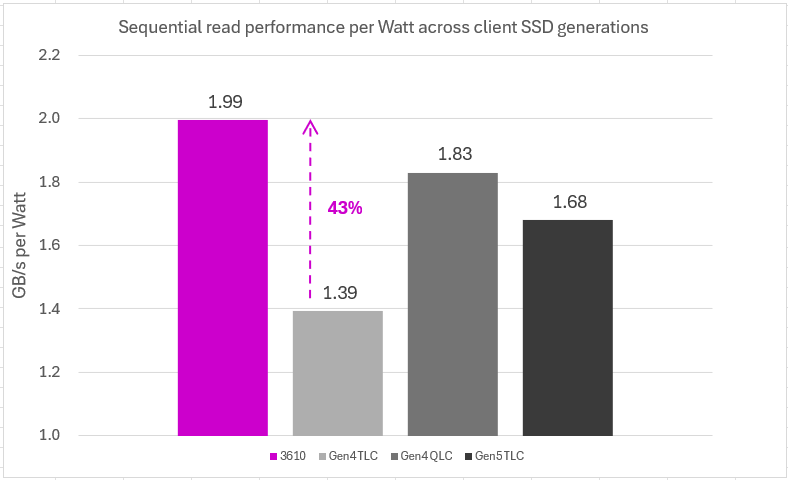
CrystalDiskMark benchmark5 was conducted in the Micron lab and the performance and corresponding power consumption for the 3610 SSD with other SSD products were compared. For example, the sequential read speed for the 3610 2TB device was measured at 11.08 GB/s, with an average power consumption of 5.56W, resulting in a performance per Watt metric of 1.99 GB/s per Watt, as illustrated in the figure above. The findings demonstrate that the 3610 SSD achieves the most favorable sequential read performance per Watt metric among the SSDs under evaluation. To highlight, the data showed that 3610 surpasses Gen4 TLC SSDs with sequential read performance per Watt up to 43% higher. As sequential read for SSDs is particularly significant for tasks involving large files and continuous data processing, optimizing this metric in the 3610 SSD will directly translate to more efficient data access and transfer, potentially benefiting high bandwidth edge AI use cases such as on-device AI agent, image/video creation and editing, gaming, etc.
Looking forward
Micron’s advancements in power efficiency with 3610 marks just the beginning of its ongoing dedication to innovation. As Micron G9 NAND and Micron 1γ (1-gamma) DRAM technologies mature and their innovations inform next generation NAND architecture and memory design, we expect to unlock new levels of energy efficiency designs that will be essential as edge AI workloads grow in complexity and client devices continue to get thinner, lighter, and more thermally constrained. In addition, Micron’s deep expertise in system-level optimization solidifies its role as a trusted partner for platform providers and OEMs, helping us remain competitive in the rapidly evolving landscape of AI-ready client and edge devices.
Visit Micron 3610 SSD webpage to learn more.
References
- Power statements are based on 2TB PCIe Gen5 Micron 3610 SSD compared to 2TB PCIe Gen4 Micron 3500 SSD, 2TB PCIe Gen4 Micron 2600 QLC SSD, and 2TB PCIe Micron 4600 TLC SSD, tested in Micron lab, at the time of product announcement.
- Fortune Business Insights, Edge AI Market Size, Share, Growth & Global Report [2034].
- Market.us, Edge AI Market Size, Share, Trends | CAGR of 23.8%.
- Assumptions: Battery capacity is 10,000mAh; battery efficiency is 80%, battery voltage is 3.7V.
- Crystal Disk Mark is a widely adopted industry benchmark for evaluating client SSD performance under standardized sequential and random workloads. Its repeatability and consistent workload definitions make it suitable for comparing performance per watt across SSD generations and NAND technologies in client platforms.