


Built for demanding edge recording workloads
Industrial storage for intelligent video
- AI-enabled security cameras
- Cloud-connected cameras
- AI box platforms
- Remote and infrastructure-light systems

AI-enabled security cameras
Support continuous high-resolution video recording alongside event metadata, embeddings and advanced AI outputs.
Explore video security

Cloud-connected cameras
Enable reliable local storage for firmware, AI models, configuration data, video and AI-generated insights within cost-optimized camera designs.
Explore edge AI

AI box platforms
Add edge AI analytics to existing camera deployments without replacing installed cameras, with local storage for applications, AI models, video and AI-generated data.
Explore AI solutions

Remote and infrastructure-light systems
Enable local intelligence and data retention for mobile, solar-powered, LTE- and 5G-connected deployments where cloud connectivity may be limited or intermittent.
Explore video security
Meet the Micron i500 microSD card for intelligent video
The Micron i500 microSD card gives intelligent cameras reliable, high-capacity edge storage for video, software and AI data. Advanced Media Management, protected storage and health monitoring help maintain recording performance, safeguard critical assets and support proactive maintenance.


i400 vs. i500 memory cards: specifications and difference
Compare the i400 and i500 memory cards across the specifications that matter most when choosing a card, including capacity, performance, and compatibility.
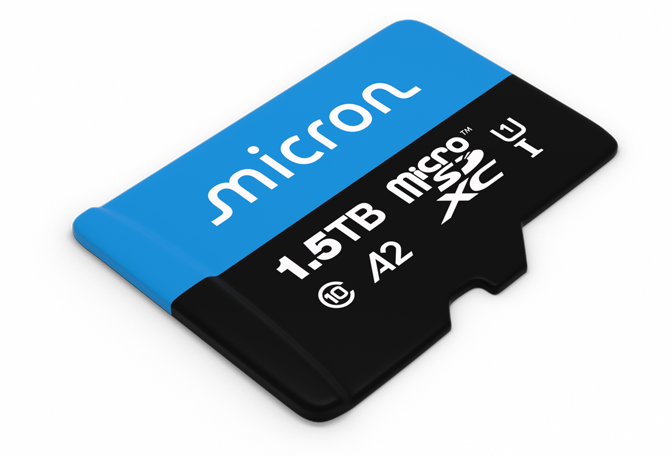 | 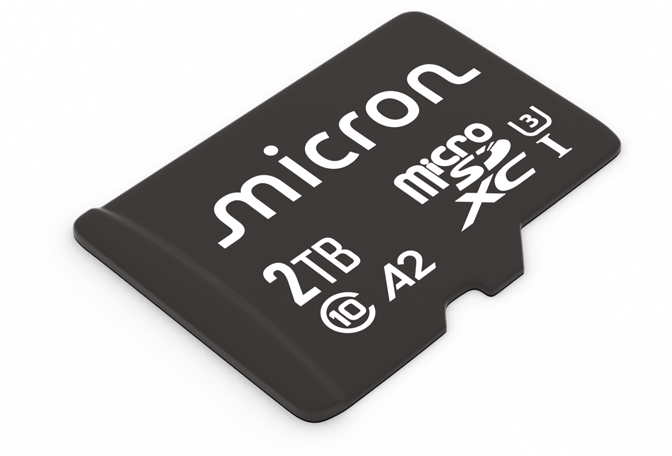 | |
i400 memory cards | i500 memory cards | |
|---|---|---|
| Form factor | microSD UHS-I | microSD UHS-I |
| Capacity | 64GB, 128GB–1.5TB | 256GB–2TB |
| Application |
|
|
| Reliability |
|
|
| Sequential speed |
|
|
| Random speed |
|
|
| Operating temperature | UHS-I C10, U3, A2 | UHS-I C10, U3, A2 |
| Environment |
|
|
| Card management |
|
|
| Warranty | 3-year | 3-year |
Resources


Frequently Asked Questions
Industrial microSD cards provide removable storage for systems that generate and keep data at the edge. Micron designs its cards for applications such as IP video security cameras, where they add recording redundancy, reduce network load and help lower total cost of ownership.
A microSD card records and stores video inside the camera instead of sending every recording across the network to a central facility. This provides recording redundancy, reduces network load and supports cloud-based and AI-enabled video security applications.
Video security cameras can write data around the clock, so endurance is a key factor when selecting storage. Micron industrial microSD cards are designed to support up to five years of high-quality, continuous 24/7 video recording.
Micron industrial microSD cards use firmware optimized for stable performance during continuous, high-quality video recording. The firmware is designed to minimize frame drops and potential video loss during sustained recording workloads.
Memory card health monitoring reports card usage and estimated remaining life. When integrated into an IP camera's system software, it can help alert users when a card may need attention or replacement.
Industrial microSD cards are designed for systems that need sustained recording performance, endurance and reliability. Micron industrial cards pair NAND flash memory with application-optimized firmware to support continuous video workloads.
Engineers should compare capacity, continuous-recording endurance, sustained performance, operating temperature and health-monitoring support against their system and workload needs. The storage solutions portfolio and memory card part catalog offer more product detail.