



Why LPDDR5X matters
Micron launched LPDDR5X in 2022 for flagship smartphones and client PCs. While LPDDR6 is widely discussed as the next step in bandwidth expansion and architecture advancement, LPDDR5X remains the flagship and mainstream choices because of its technology maturity, strong performance, and power efficiency.
In 2025, the LPDDR5X market began growing rapidly, driven by rising demand from AI-powered devices and constrained supply. The market is forecast to reach $8.3 billion by 2026, with a projected compound annual growth rate (CAGR) of 6.8% through 2033.1
To help customers meet rising edge AI demands, Micron continues to expand its portfolio of low-power memory solutions. Last summer, we introduced the world’s first 1-gamma (1γ)-based LPDDR5X, opening new possibilities for smartphones, PCs, and other edge systems. The latest addition to this portfolio further expands what customers can design and deliver.
What’s new in Micron’s 1γ non-binary LPDDR5X
Micron’s new non-binary LPDDR5X adds 6GB, 12GB, and 24GB capacity options beyond standard binary multiples, giving customers greater design flexibility. Built on Micron’s 1γ process node, the solution delivers higher performance2 with mobile-class power efficiency, increased bandwidth, longer battery life, and scalable reliability for next-generation intelligent devices.
Capacity choices for different product tiers
This non-binary LPDDR5X DRAM solution supports multiple product tiers with 6GB, 12GB, and 24GB capacities. The 6GB option is well suited for value-tier devices, while 12GB, together with existing 8GB and 16GB options, gives mainstream designs more flexibility. For performance-tier products, 24GB enables greater data processing capability, making it especially useful for edge AI applications.

Performance and power improvements
Along with broader capacity choices, customers gain higher performance and improved power efficiency across all options,2 reducing the need to choose between lower-capacity, lower-performance LPDRAM and higher-capacity, higher-performance devices.
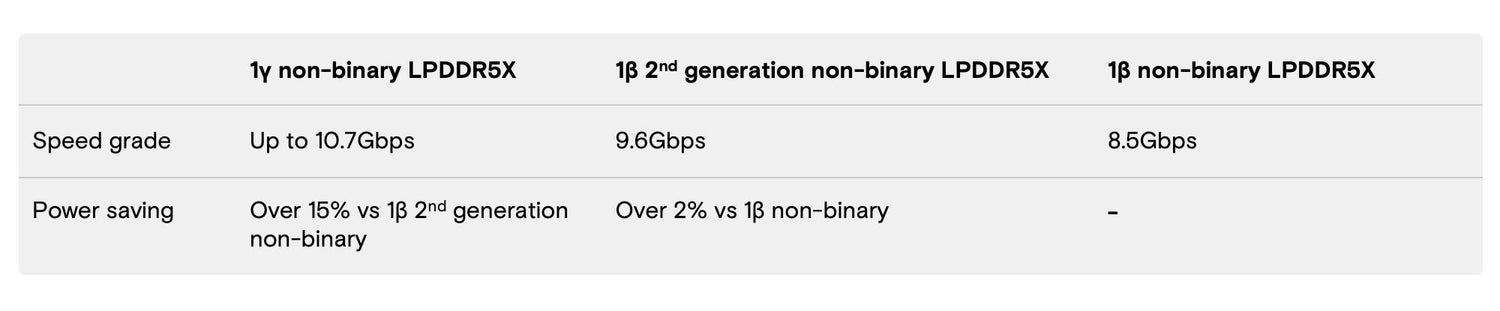
As shown in the table below, the new non-binary LPDDR5X supports speeds up to 10.7Gbps, 11% faster than the previous generation.3 The added bandwidth enables more responsive edge AI experiences, such as faster real-time language translation, quicker image analysis, and more responsive personal assistants.
System test in Micron lab on a mobile platform showed more than 15% total power savings in real-world use cases compared with the previous generation.2 Similar results across Day of Use (DoU) and High Bandwidth (HBW) scenarios indicate potential battery life improvements for mobile applications.
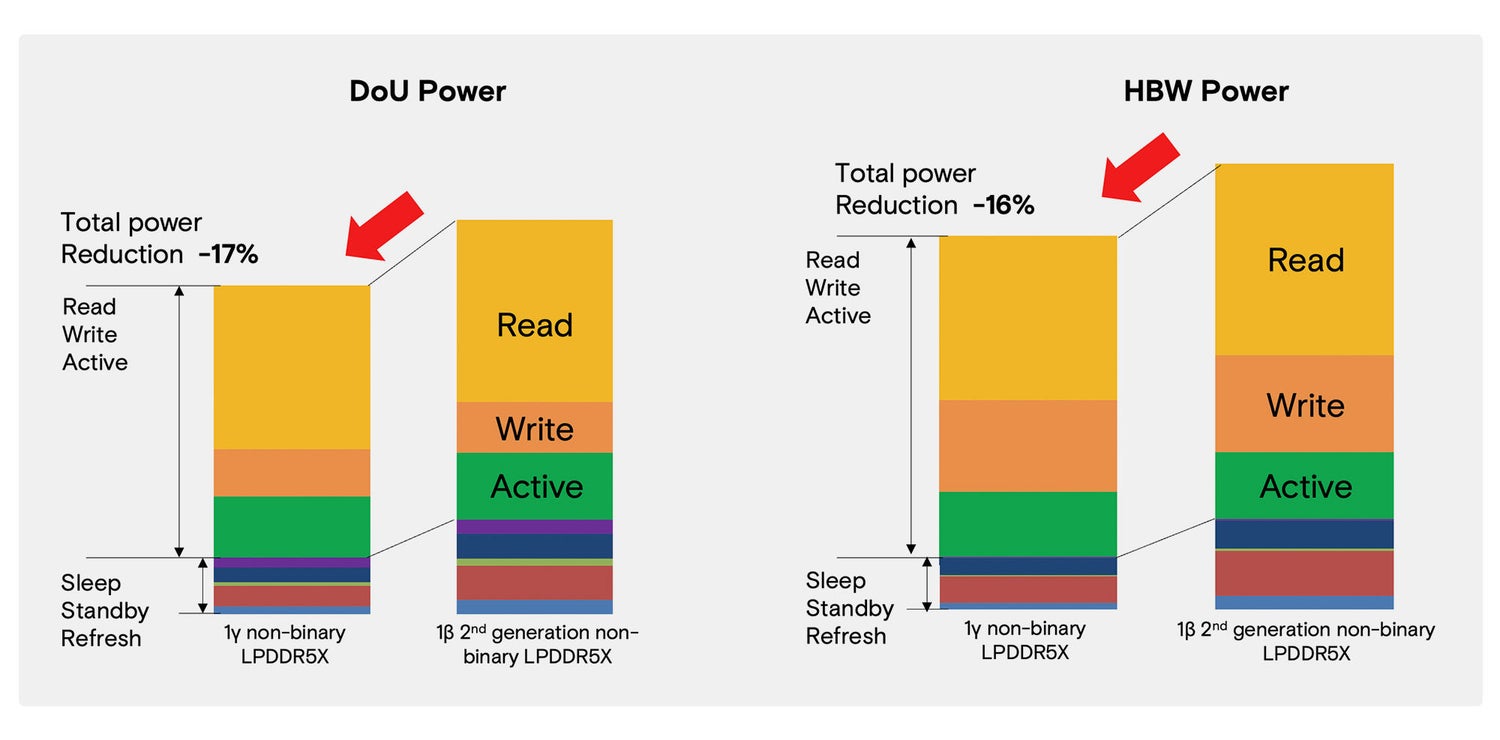
Click image to expand
Package options for more design flexibility
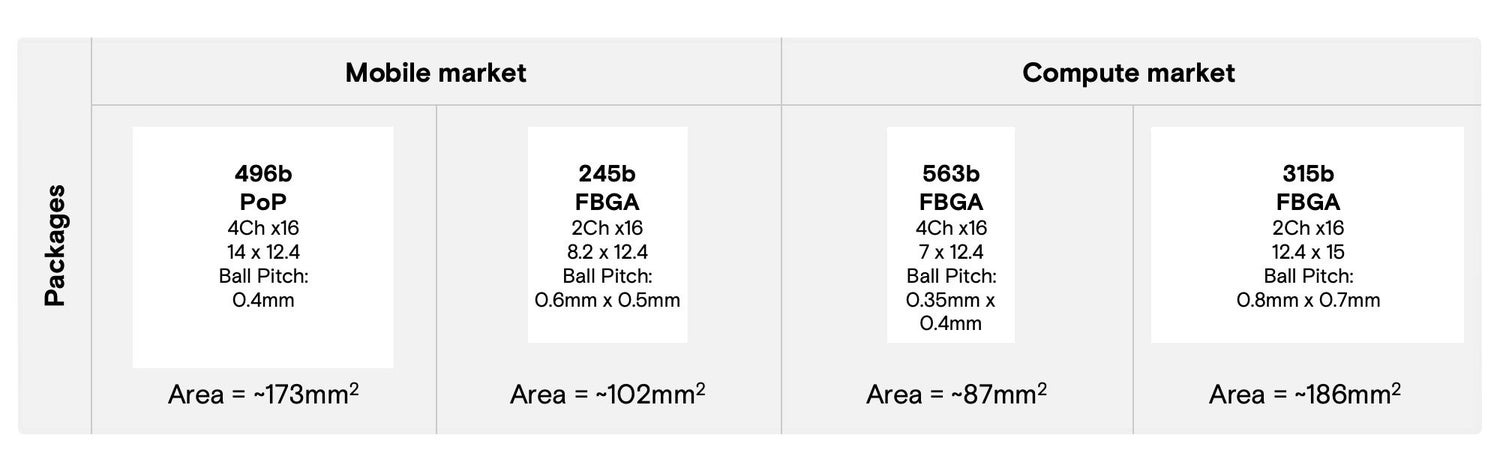
This new non-binary LPDDR5X DRAM solution is designed for both mobile and client PC applications. The 496b package-on-package (PoP) remains the primary choice for flagship smartphones, while the compact 245b fine-pitch ball grid array (FBGA) package is gaining traction in mobile devices. For client PCs, 563b and 315b packages are the main options. The 563b package offers superb heat dissipation through its single stack configuration, making it a strong fit for systems with more demanding thermal requirements. OEMs are also interested in evaluating the 563b package to streamline both mobile and client PC designs.

Ecosystem and customer validation
As key ecosystem partners increase LPDDR5X sourcing for next-generation platforms, and leading mobile and client PC manufacturers integrate it into new devices, Micron remains committed to support customers and partners with this latest LPDDR5X solution with greater design flexibility and higher performance.
We have already delivered non-binary LPDDR5X samples to key ecosystem partners to support their latest platform integrations and are collaborating closely with them through validation and qualifications. Samples have also been sent to major customers, with testing and market adoption expected to begin soon.
“The range of capacities and package options in Micron’s latest non-binary LPDDR5X allows us to efficiently tailor mobile products (especially smartphone and tablet) designs to meet diverse user needs and market segments.” said Bill Li, R&D director of Lenovo Mobile.
“Lenovo has worked closely with Micron for many years,” said Tadashi Kosuga, Distinguished Engineer & Executive Director, Commercial Subsystem Development, CPSD at Lenovo. “The latest non-binary LPDDR5X gives us a strong combination of performance, power efficiency, and design flexibility. With multiple capacities and package options, it helps us tailor PC designs to different product needs and market segments.”
What’s next for edge AI memory
In today’s edge market, flagship and mainstream product designs require low-power DRAM built on mature technology with greater design flexibility. As AI workloads expand across edge devices, performance and power efficiency are becoming increasingly important. Micron’s latest non-binary LPDDR5X is designed to address these needs and help enable the next wave of innovation.
See how Micron’s new non-binary LPDDR5X can support your next design.
References
- DataInsightsMarket. (2026, May 6). LPDDR5X DRAM market dynamics and growth analysis. https://www.datainsightsmarket.com/reports/lpddr5x-dram-1498822
- Performance is based on 12GB Micron 1γ non-binary LPDDR5X compared to Micron 1β 2nd Generation non-binary LPDDR5X, test in Micron lab, at the time of product announcement.
- Based on comparing to Micron 1β 2nd Generation non-binary LPDDR5X, which has a speed grade of up to 9.6Gbps.